The Silent Pressure of Being the Responsible One
The ones who carry everyone's burdens often have no one to share their own. Behind their constant strength lies a heart that is quietly asking for a little understanding, love and care.

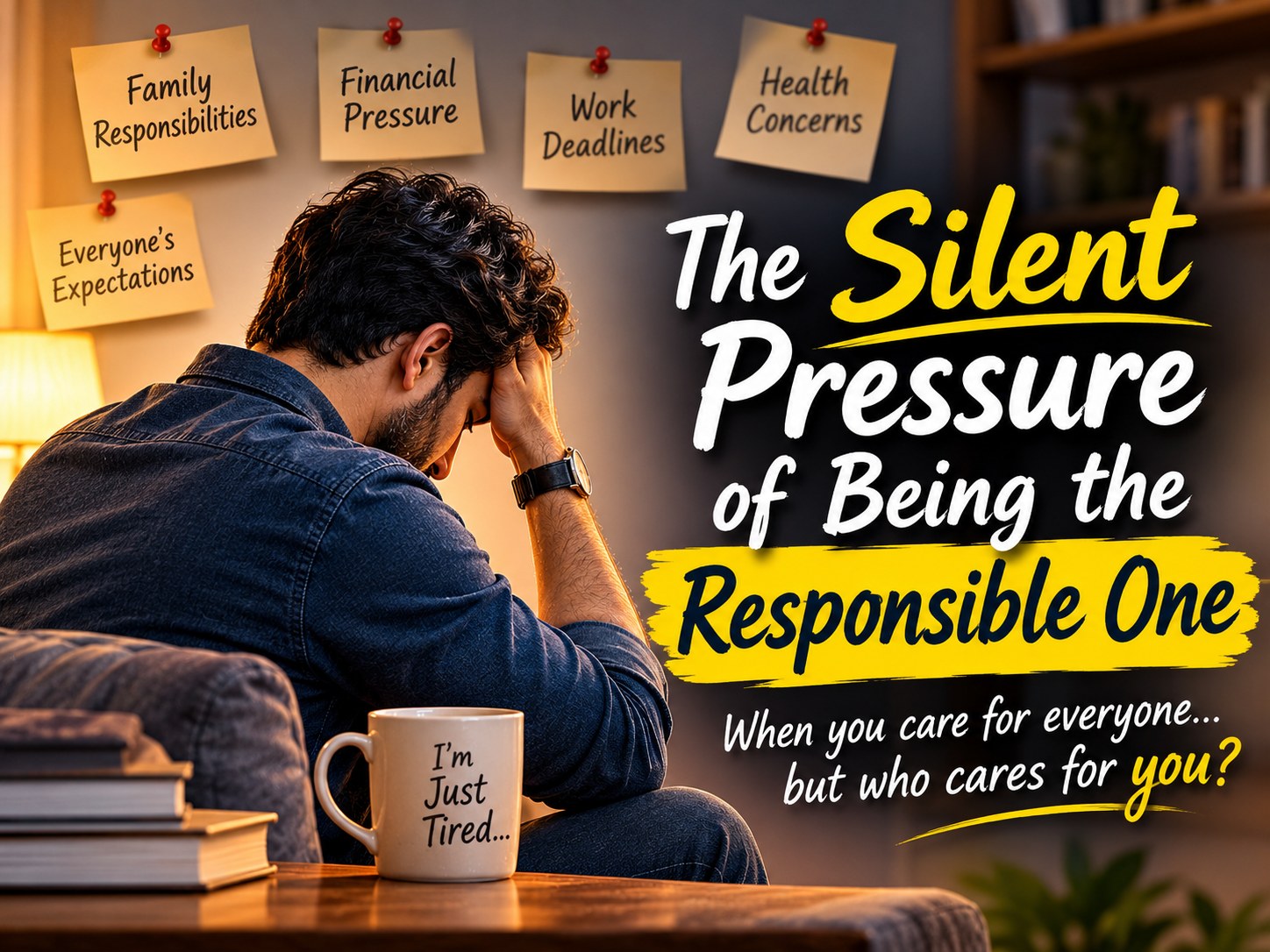
Sometimes, the person who holds everyone together is the one quietly falling apart.
There is a particular kind of tiredness that sleep cannot fix.
It belongs to the person who is always expected to understand, always expected to manage, always expected to find a solution. The person everyone calls when something goes wrong. The one who remembers everyone's needs, worries about everyone's future and somehow finds a way to make things work, even when life becomes difficult for them.
We often call such people strong. We admire their patience, appreciate their sacrifices and depend on their ability to handle almost anything.
But have we ever stopped to wonder what happens to them when they cannot handle things anymore?
Who do they call when they have a problem?
Who notices when their smile is not genuine?
Who asks them, without needing anything in return, "Are you really okay?"
Perhaps the saddest part of being the responsible one is that people become so accustomed to your strength that they forget you are human too.
The person everyone depends on
In almost every family, there is someone who carries more than their share of responsibility.
It might be the eldest son who starts working early because his family needs financial support. It might be a daughter who quietly manages the household while trying to build her own future. It might be a father who leaves home every morning with a thousand worries but returns with a smile because his children are waiting. It might be a mother who somehow remembers everyone's appointments, preferences, meals, problems and emotions, while nobody remembers to ask whether she has rested.
And sometimes, it is simply someone who has never been given the luxury of saying, "I cannot do this today."
They become the problem-solvers of the family.
A broken appliance, an unexpected bill, a school issue, a medical appointment, a financial difficulty or a family disagreement — somehow, everything eventually reaches them.
People don't necessarily do this because they don't care. They do it because they trust them.
They know this person will find a way.
But what they don't see is the pressure behind that trust.
The responsible person may be sitting quietly at the dinner table, participating in a normal conversation, while mentally calculating next month's expenses, thinking about an unfinished task at work, worrying about a family member's health and wondering how to manage something that nobody else even knows about.
They are physically present, but their minds rarely get a break.
And the world keeps expecting them to be fine.
When your own problems become the least important
There is something heartbreaking about having a problem but feeling that you cannot afford to have one.
Imagine someone who has had a terrible day at work. Perhaps their manager has criticised them, a project has failed or they are simply exhausted from carrying responsibilities that seem to have no end.
They come home hoping, even for a moment, that someone might notice.
But before they can even sit down, someone asks about a payment that needs to be made. A family member needs help. Something has gone wrong. Someone wants advice.
And they get up again.
They put their own feelings aside and start fixing things.
Not because they have no feelings, but because they have learned that other people's needs cannot wait.
Over time, something changes inside them.
They stop sharing their problems. They stop explaining why they are upset. They stop expecting anyone to understand.
When someone asks, "What's wrong?" they simply say, "Nothing, I'm just tired."
And sometimes, that is the most honest answer they can give.
They are tired of worrying. Tired of making decisions. Tired of being available. Tired of pretending that everything is under control.
But most of all, they are tired of feeling that they must remain strong even when they desperately need someone to be strong for them.
The tears nobody sees
Perhaps one of the most painful things about being the responsible one is learning how to cry without being noticed.
It might happen late at night, after everyone has gone to sleep.
The house is finally quiet. There are no questions, no demands, no phone calls and no one asking for anything.
And suddenly, all the emotions that were held back during the day begin to surface.
A person who spent the entire day solving other people's problems may sit alone and struggle with their own.
They might look at their bank account and wonder how they will manage the next few months.
They might think about their ageing parents and feel guilty that they cannot spend enough time with them.
They might worry about their children's future, their job security or a responsibility they have not yet fulfilled.
Sometimes, they don't even know exactly why they are crying.
It is just everything.
The pressure that has been building for months. The words they never said. The disappointments they never discussed. The dreams they postponed because someone else needed them first.
They wipe their tears, take a deep breath and go to bed.
The next morning, they wake up, prepare themselves and continue.
Nobody knows that the person who greeted them with a smile that morning had spent part of the previous night silently breaking down.
And perhaps nobody will ever know.
The sacrifices that slowly become invisible
There is another side to this responsibility that hurts in a different way.
When someone repeatedly sacrifices for others, those sacrifices can eventually become expectations.
The first time they help, people appreciate it.
The second time, they are thanked.
The tenth time, it becomes normal.
And after years of doing it, people may not even notice anymore.
Think about the person who always pays the extra expense when the family budget falls short.
The one who cancels personal plans because someone needs help.
The one who delays buying something for themselves because another family member needs it more.
The one who never complains about working late because the household depends on their income.
At some point, their sacrifices stop looking like sacrifices to everyone else.
People begin to assume that they can manage.
And this is where a quiet sadness develops.
They don't necessarily want applause. They don't want everyone to stand up and thank them for every little thing.
Sometimes, they just want someone to notice.
Someone to say:
"I know you've been doing a lot."
"Don't worry about this one. I'll take care of it."
"You deserve a break."
It may sound like nothing, but for someone who has spent years carrying everything, those words can mean more than we realise.
Because sometimes, people don't need someone to solve their problems.
They just need to know they don't have to face everything alone.
The burden of never disappointing anyone
Responsible people often carry another invisible burden: the fear of letting people down.
They become so accustomed to being dependable that saying no starts to feel like a personal failure.
Even when they are exhausted, they agree to help.
Even when they have their own difficulties, they listen to someone else's.
Even when they desperately need time for themselves, they feel guilty for taking it.
They may think:
"If I don't do it, who will?"
"What if things go wrong because of me?"
"What will happen if I stop managing everything?"
These questions slowly become part of their everyday thinking.
And the most difficult part is that nobody may have actually asked them to carry all of this alone.
Sometimes, they simply took responsibility because somebody had to.
Perhaps they grew up watching their parents struggle. Perhaps they were the eldest child. Perhaps life forced them to become mature before they had the chance to enjoy being young.
Whatever the reason, they developed a habit of putting everyone else first.
But there is a difference between being responsible and believing that everything is your responsibility.
No one person can carry an entire family's happiness, financial stability, emotional wellbeing and future on their shoulders.
Yet many people spend their entire lives trying.
The dreams they quietly put away
There is something particularly painful about thinking of the dreams that responsible people never get to pursue.
Remember the young person who once wanted to travel, study something different, start a business or simply enjoy life without constantly calculating expenses?
Perhaps they had plans.
Perhaps they wanted to buy something for themselves, move to another city or take a chance on a career they genuinely loved.
But then life happened.
A parent's health required attention. A sibling needed education. The family needed financial support. A responsibility arrived earlier than expected.
And slowly, their dreams moved to the bottom of the list.
Not because they stopped dreaming.
They simply became better at postponing their dreams.
Years later, they might look at an old photograph, an unfinished project or something they once wanted to become.
For a moment, they may wonder what life would have looked like if circumstances had been different.
They might smile and say, "Maybe one day."
But deep inside, they know that some opportunities do not wait forever.
And that is a quiet grief too — grieving a version of yourself that never got the chance to exist.
It is not that they regret helping their loved ones. Most would probably make the same sacrifices again.
But that does not mean the sacrifices never hurt.
Both things can be true.
You can love your family deeply and still wish life had been a little kinder to you.
The strange loneliness of being needed by everyone
One of the biggest misunderstandings about responsible people is that they must be surrounded by support because so many people depend on them.
But being needed is not the same as being understood.
Someone can receive dozens of phone calls in a day and still have nobody to call when they feel lost.
They can be surrounded by family and still feel emotionally alone.
They can be respected at work, appreciated by friends and loved at home, yet struggle to find a place where they don't have to be the strong one.
Because everywhere they go, they are somebody's dependable person.
At work, they are the colleague who handles difficult situations.
At home, they are the person who makes things happen.
Among friends, they are the one who gives sensible advice.
But who are they when nobody needs anything from them?
Do they even remember how to relax without feeling guilty?
Can they sit quietly without thinking about the next responsibility?
Can they admit that they are scared without worrying that someone will lose confidence in them?
Sometimes, what they need most is not another achievement, another promotion or another financial milestone.
They need a place where they can simply be themselves.
A place where they can say, "I'm not okay today," and know that nobody will judge them.
A little understanding can change everything
We often talk about respecting our parents, appreciating our partners, valuing our siblings and supporting our friends.
But perhaps we should pay more attention to the people who rarely ask for support.
Look around your home.
Is there someone who always handles the difficult conversations?
Someone who takes care of the bills?
Someone who never seems to need anything?
Someone who quietly makes sure everyone else is comfortable?
Don't assume that they are doing well simply because they never complain.
Ask them how they are feeling.
And when they answer, listen.
Don't immediately turn the conversation towards another problem that needs solving.
Don't tell them that they are strong enough to handle it.
Sometimes, that is exactly what they are tired of hearing.
Offer to take something off their shoulders. Give them a day without responsibilities. Make them a cup of tea. Sit with them without expecting a conversation.
And if they tell you that they are struggling, don't make them feel guilty for it.
Remember, even the strongest people need somewhere to put down their burdens.
And if you are the person who has been carrying everything, perhaps it is time to understand something yourself:
You are allowed to rest.
You are allowed to say no.
You are allowed to have dreams of your own.
You are allowed to make mistakes.
You are allowed to need help.
Your worth is not measured by how much you can sacrifice for others.
You don't have to destroy yourself to prove that you love the people around you.
Before you go, think about this...
One day, the people you have spent your life taking care of may look back and realise how much you did for them.
They may remember the school fees you paid, the difficult decisions you made, the opportunities you gave up and the countless times you showed up when things were falling apart.
But wouldn't it be wonderful if they didn't have to wait until that day to appreciate you?
Wouldn't it be better if they noticed while you were still sitting beside them?
If they understood your tiredness before it turned into silence?
If they offered you a little comfort before you reached your breaking point?
Because the person who holds everyone together also deserves to be held together sometimes.
And perhaps the most heartbreaking sentence a responsible person can say is not, "I have too many problems."
It is:
"Don't worry about me. I'll manage."
They have said it so many times that everyone has started believing it.
But maybe, just once, we should stop accepting that answer.
Maybe we should look into their eyes and say:
"Not this time. You've done enough. Let someone take care of you for a change."
A question for our readers:
Have you ever been the person everyone depends on, the one who keeps everything together while quietly struggling inside? Or is there someone in your life whose sacrifices you have perhaps never fully acknowledged?
Share your thoughts. Sometimes, a few honest words can make someone feel that they are not alone.
And if you know someone who always says "I'll manage", perhaps this is the time to check on them.